....I had the please of attending the Friday and Saturday nights of the recent Endurance Conference here in Vancouver. I've always been a believer in analyzing training methodologies first and foremost and this gave me an opportunity to tweak things are confirm some ideas.
The one area I hope people there did follow was how we need to leave some of our old training models on the back burner (actually go back more in time and keep those models...'old school'). The concept of the low mileage high intensity of the late 80s and 90s (and even into modern times) was pretty much destroyed by three of mid/dist coaches there (James Li, Alberto Salazar and Dave Scott-Thomas). I am still amazed that people havent' gone out of their way in this day and age of internet and freedom of information to find out what most successful coaches/athletes have done/are doing (not the genetic freaks, but rather the avergae athlete). The funniest presenter was Dave who when he said he first began recruiting for Guelph people used to comment that his was the school that ran too much/a lot. I highly doubt anyone is saying that anymore....
The first night was also a great way to begin with a Li Salazar showdown (kidding), but it was good to see both the similarities and differences between Li's slightly less volume (although still decent volume) and more athlete directed model vs Salazar's more higher mileage more coach controlled model. Where as Salazar was all about specifics Li offered the honest admission that he doesn't actually know how much actual volume Bernard Lagat runs per week. As wel Lagat does a lot of tempo style sessions to offset his lower volume mixed in with some really solid speed session. As well, he added that they do a lot of hills and more 'feel' workouts, whereas Salazar was very specific in his paces and on the track which reminds of Henry Rono's famous diatribe after a few beers where he said salazar was on the track all the time while he was out running 'any hill'....
.
As always the key was in getting athlete to believe in their training and by and large that involved allowing athletes an ownership in their training. Although I don't disagree with this statemtn if I have learned anything over the last handful of years it's how little some athlete truly know about training paradigms. Maybe it's because they've been under coaches who 'controlled' them, but I am often amazed when some athletes don't have an idea of what they might do if a coach isn't around. If there's one area i have stressed to young athletes it's find out stuff for yourself and treat running as a form of enlightenment. The lesson learned are not mine....these are theirs.....
I am sure some more meandering things might hop into my head, but i realized that for right now I just need to keep this thing updated regularly.
Wednesday, December 14, 2011

Sunday, December 4, 2011
On the wagon....
...the body has finally been solid for the last 6 months and that's finally resulted in some decent running results. I took a really patient apporach since the summer and planned on a very short, but hopefully successful late season racing for crossy. it turned out I did just enough to win the BC masters in oct and about a month later the Canadian crossy champs.
Training lacked a ton of structure, but it was reletively consistent. I kept it simple with some classic sessions (egs 30-40min of hills, 8-10 x 3mins off 1min, 20-25 min hard tempos and 2 x 20mins off 5min good paced runs at just under threshold) mixed in with 100min and the odd 2 hr long runs. I was averaging about 120-130km, but only off 6 days per week of running.
I was pleasantly suprised with the BC cross results as I had run a low key XC race up at Whistler. I felt terrible there, but BCs felt really easy. At BCs I played it pretty patient and threw in a medium surge at around 5-6km (of an 8km race) and dropped Craig Odermatt. Considering how well Odie has been running this fall I was pleasantly happy.
At Canadians, I felt pretty confident. I'd done a few sessions with one of the athletes I've been coaching. He had no training partners after CIS champs and so we did a few session together. The key was I was running easy and I dropped him easily in the sessions. I knew he was in good shape so this was a nice confidence boost.
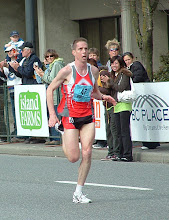
The day of the race it had been raining all night and morning and the course was pretty muddy. I've never been a mudder and figured my fitness might be offset by the mud.At Canadians there were a few questions marks (Grame Wilson and Steve Boyd), but after 1km I knew unless someone began to hammer early this was my race to lose. At around 2km Boyd threw in what felt like a pretty good surge and I answered it easily and then went past Steve. At that point things felt so easy that I just began to control the race in leading at times and follwoing when I wanted. By 6km it was just me and Odie once again and with about 1km to go I threw in one big surge up a hill and dropped Odie. From there it was just run relaxed to the end. It was some of the most fun I have had running in years...
Training lacked a ton of structure, but it was reletively consistent. I kept it simple with some classic sessions (egs 30-40min of hills, 8-10 x 3mins off 1min, 20-25 min hard tempos and 2 x 20mins off 5min good paced runs at just under threshold) mixed in with 100min and the odd 2 hr long runs. I was averaging about 120-130km, but only off 6 days per week of running.
I was pleasantly suprised with the BC cross results as I had run a low key XC race up at Whistler. I felt terrible there, but BCs felt really easy. At BCs I played it pretty patient and threw in a medium surge at around 5-6km (of an 8km race) and dropped Craig Odermatt. Considering how well Odie has been running this fall I was pleasantly happy.
At Canadians, I felt pretty confident. I'd done a few sessions with one of the athletes I've been coaching. He had no training partners after CIS champs and so we did a few session together. The key was I was running easy and I dropped him easily in the sessions. I knew he was in good shape so this was a nice confidence boost.
The day of the race it had been raining all night and morning and the course was pretty muddy. I've never been a mudder and figured my fitness might be offset by the mud.At Canadians there were a few questions marks (Grame Wilson and Steve Boyd), but after 1km I knew unless someone began to hammer early this was my race to lose. At around 2km Boyd threw in what felt like a pretty good surge and I answered it easily and then went past Steve. At that point things felt so easy that I just began to control the race in leading at times and follwoing when I wanted. By 6km it was just me and Odie once again and with about 1km to go I threw in one big surge up a hill and dropped Odie. From there it was just run relaxed to the end. It was some of the most fun I have had running in years...
Thursday, August 25, 2011
I've been too busy too write here....(Flotrack Interview)
.....becuase I've been writing here:
http://www.flotrack.org/article/7014-Mark-Bomba
Thanks for Chris for fixing all my typing and grammatical errors.....
FYI training is going well...achilles is good.....hmmmmmmm.......
http://www.flotrack.org/article/7014-Mark-Bomba
Thanks for Chris for fixing all my typing and grammatical errors.....
FYI training is going well...achilles is good.....hmmmmmmm.......
Friday, May 27, 2011
It's been a long time coming....
This post has been a long time coming. It was meant for months ago, but my ‘princess’ kinda got in the way...it's the idea that to experience the really good, you have to first experience the really bad and thatevery once in a while 'things click'...
In my own running I’ve had to overcome (as I have been quoted ‘stupidly’ refusing to quit) some major injuries in my career (two car accidents amongst many stupid injuries and even now still having an impact from getting hit on a run a few years ago) that when the good things happened they were extreme in their emotions. To have tried to run competitively well into my mid-late 30’s goes beyond any reasonable and rational thought, so why……well one has always been the challenge (see my philosophy ideas a few posts ago), but another has been a belief that I had more to give.
I knew that getting hit by a car in 1995 had seriously messed up my back (to the point where I didn’t seriously run for 4 years) and that I had lost the ‘prime’ years of training adaptations and experiences that could never be taken back. But I also knew that I had never come close to reaching my talent levels in the early 90s and that somehow kept me going.
As it would turn out I was right. Although I never came close to running my best race from a time perspective (read time trial race) I was able to race to levels where I knew I should be…. One such time was the year I shocked the Canadian running world in winning the XC champs. No one had even picked me in their top 10, nevermind winning I knew going in that the race was mine to win.
The odd fact (sounding arrogant, but not meant to) was when Paddy McCluskey (someone I have a great amount of respect for in regards to getting the most out his talent) asked me when I knew I was going to win. The answer that came quickly out my mouth was ‘July’. The people around Paddy looked shocked but Paddy got it.
The reason for my answer was simple I had told my future wife in July of that summer, I was going to win Canadian XC champs. I am sure she thought I was blowing smoke. I had placed 12th two years earlier, but knew I was on the cusp of taking it to a new level. To make such a statement might seem crazy, but I truly believed that I could achieve such a goal. I knew that there were only three guys I could not beat no matter what (Kevin Sullivan, Jeff Schiebler and Sean Kaley, but this was also the fall of 2000 and all three had just competed in the Sydney Olys) if I followed through on the training and could get back to the place I had been the previous spring.
What no one knew was that I had had a great spring of training and was on the verge of running some very good 5kms before I would suffer my first achilles injury. I also knew that fall that I had been much faster than when I had placed 12th (in a race I was disappoint in). So off I went putting in 3 x per week Grouse Grind tempo workouts, doing 2 x 2-3 hr bike ride per week along with other various training until could run. Even then I was only beginning to run in late August.
What would transpire over the next few months would quite simply be the model I would continue to follow for the many more years. Taking a patient and process oriented approach to training. I knew the goal and ignored everything else along the way, except as part of the process. All my eggs were in one basket.
Things started out relatively well. In early October, on a slowish course (I’ll assume because some good guys ran slowish times) and early in the season I ran a bit over 30mins for 10km. Not blistering, but I also split 15:15 through 5km and was off the back til I regrouped and moved up to 4th. The real key was that I had only just begun doing intervals (before that it was hills, fartleks and tempos) and knew that something special was happening in my training. Every week got better and every session felt solid. I was hitting my ‘magical spot.
Things got a bit better at the BC XC champs (I was 3rd), but once again the intervals were just beginning to take control. I knew that my timing was on track....until....the annual Haney to Harrison relay. I was training like a maniac and had the feeling of nothing could get in my way, til I bit off more than I could chew. I ran against a very fit Graeme fell at that time and after about 10mins i was done. I hung on for dear life as Graeme simply crushed me into the ground (I lost over 2mins to him over about 14km). I remember saying to Graeme how the leg of Haney had killed me, but even in getting killed I was still confident in where I was going. It was all part of the process.
What no one knew at the time was that I had done a hard 40min hill session on the Thurs night. Haney was nothing more than a training run and in looking at previous yr’s times (and even since then) I hadn’t run that poorly. Graeme had simply run that well (He went just over 42 mins that yr and only a few people have even gone just under 44mins). The result of Haney was once my legs recovered by our annual Tuesday night interval session I was absolutely rolling. Things had gone to a new level. A week later I knew that I was now going from nobodies top 10 pick to a chance to medal. I can remember it like it was yesterday as we did a session of 1km-2km-1km-2km-1km off 2mins. I knew this was my lat harder interval session I simply ran away from everyone at practice...and it felt easy. Everything was coming together as planned.
In talking to my coach at the time, about a week before the race he felt I could make the team. My response was simply ‘I know’. What he didn’t know was that I was thinking much bigger than that. I had 3 simple goals 1) make the team outright 2) top four 3) top two. The first goal was where i thought I’d be if I had a bad race (seriously) and goal 2 was where I thought I’d be if I simply ran okay...but goal was 1 was the real goal.
At that years Canadian XC champs everything played out like it was destiny. We got into -15 degrees weather, but by race day it was closer to + 10. The course was simply my kind of course. It was a three km route that mostly flat with a few smallish hills and firm (I hate the mud). Even the race went out as I had planned to focus on Paddy after one of his teammates told me he was going to take out around 8km (of the 12km race). I watched Paddy, knowing he was far more experienced than me at this stuff and when I saw him make a slight move at 5km I began to move up, but as I did so I went past Paddy and immediately caught up with the leaders (at this moment in time the two main players were Graham Cocksedge and Peter Cardle). I thought to myself....’well since you’re here you might as well hang out for a while’ (if you know my general tactics they are to wait as late as possible). But in hanging out with the lead guys I felt as though I was jogging. Once again I thought....’it can’t be this easy’. As it turned out it was. Graham through in a surge at around 7km and Peter countered. I was gapped a meter or so and responded by following Peter who soon went by Graham. As soon as Pete went by Graham I slowly went by Peter and what felt easy must have been pretty quick as I soon gapped Pete. A meter turned into two and then into 3, etc....With 4kms to go I was leading a race I had no business being in (at least according to the internet predictions where I was in no one’s top 10). My thoughts once again turned into ‘well you’ve taken the lead let’s put in a decent surge and see what happens. I was running scared but I was also getting stronger and stronger. With one lap to go I looked back and had put about 5 or so seconds on Peter. I surged again and was running absolutely petrified. By the time I was at 2kms to go I was probably upward of 10 seconds on Peter and knew that I was going to win. It was everything I had within me to hold my emotions inside. All I did was wait for the last counter, but what Pete and no one else in the field knew was that I had at least another 30 seconds in me over the last mile. I simply stayed around 10 seconds until the finals straightaway where every ounce of everything negative that had ever happened to me in running came out.
From now on there would be no questioning of what I was capable of doing. There was no coulda, shoulda, woulda of what ifs. I never understood how much of that pent up energy had been so completely controlled until that moment as I was simply a blubbering mess (thankfully Peter pulled me away from the crowds and to a quiet place). I was from that moment on I would be a much more relaxed runner. I no longer had a chip on my shoulder. I had proven to myself that belief did matter and that sometimes if you do stick around long enough good things can happen. I would never be the same runner and more importantly I would never be the same person....
In my own running I’ve had to overcome (as I have been quoted ‘stupidly’ refusing to quit) some major injuries in my career (two car accidents amongst many stupid injuries and even now still having an impact from getting hit on a run a few years ago) that when the good things happened they were extreme in their emotions. To have tried to run competitively well into my mid-late 30’s goes beyond any reasonable and rational thought, so why……well one has always been the challenge (see my philosophy ideas a few posts ago), but another has been a belief that I had more to give.
I knew that getting hit by a car in 1995 had seriously messed up my back (to the point where I didn’t seriously run for 4 years) and that I had lost the ‘prime’ years of training adaptations and experiences that could never be taken back. But I also knew that I had never come close to reaching my talent levels in the early 90s and that somehow kept me going.
As it would turn out I was right. Although I never came close to running my best race from a time perspective (read time trial race) I was able to race to levels where I knew I should be…. One such time was the year I shocked the Canadian running world in winning the XC champs. No one had even picked me in their top 10, nevermind winning I knew going in that the race was mine to win.
The odd fact (sounding arrogant, but not meant to) was when Paddy McCluskey (someone I have a great amount of respect for in regards to getting the most out his talent) asked me when I knew I was going to win. The answer that came quickly out my mouth was ‘July’. The people around Paddy looked shocked but Paddy got it.
The reason for my answer was simple I had told my future wife in July of that summer, I was going to win Canadian XC champs. I am sure she thought I was blowing smoke. I had placed 12th two years earlier, but knew I was on the cusp of taking it to a new level. To make such a statement might seem crazy, but I truly believed that I could achieve such a goal. I knew that there were only three guys I could not beat no matter what (Kevin Sullivan, Jeff Schiebler and Sean Kaley, but this was also the fall of 2000 and all three had just competed in the Sydney Olys) if I followed through on the training and could get back to the place I had been the previous spring.
What no one knew was that I had had a great spring of training and was on the verge of running some very good 5kms before I would suffer my first achilles injury. I also knew that fall that I had been much faster than when I had placed 12th (in a race I was disappoint in). So off I went putting in 3 x per week Grouse Grind tempo workouts, doing 2 x 2-3 hr bike ride per week along with other various training until could run. Even then I was only beginning to run in late August.
What would transpire over the next few months would quite simply be the model I would continue to follow for the many more years. Taking a patient and process oriented approach to training. I knew the goal and ignored everything else along the way, except as part of the process. All my eggs were in one basket.
Things started out relatively well. In early October, on a slowish course (I’ll assume because some good guys ran slowish times) and early in the season I ran a bit over 30mins for 10km. Not blistering, but I also split 15:15 through 5km and was off the back til I regrouped and moved up to 4th. The real key was that I had only just begun doing intervals (before that it was hills, fartleks and tempos) and knew that something special was happening in my training. Every week got better and every session felt solid. I was hitting my ‘magical spot.
Things got a bit better at the BC XC champs (I was 3rd), but once again the intervals were just beginning to take control. I knew that my timing was on track....until....the annual Haney to Harrison relay. I was training like a maniac and had the feeling of nothing could get in my way, til I bit off more than I could chew. I ran against a very fit Graeme fell at that time and after about 10mins i was done. I hung on for dear life as Graeme simply crushed me into the ground (I lost over 2mins to him over about 14km). I remember saying to Graeme how the leg of Haney had killed me, but even in getting killed I was still confident in where I was going. It was all part of the process.
What no one knew at the time was that I had done a hard 40min hill session on the Thurs night. Haney was nothing more than a training run and in looking at previous yr’s times (and even since then) I hadn’t run that poorly. Graeme had simply run that well (He went just over 42 mins that yr and only a few people have even gone just under 44mins). The result of Haney was once my legs recovered by our annual Tuesday night interval session I was absolutely rolling. Things had gone to a new level. A week later I knew that I was now going from nobodies top 10 pick to a chance to medal. I can remember it like it was yesterday as we did a session of 1km-2km-1km-2km-1km off 2mins. I knew this was my lat harder interval session I simply ran away from everyone at practice...and it felt easy. Everything was coming together as planned.
In talking to my coach at the time, about a week before the race he felt I could make the team. My response was simply ‘I know’. What he didn’t know was that I was thinking much bigger than that. I had 3 simple goals 1) make the team outright 2) top four 3) top two. The first goal was where i thought I’d be if I had a bad race (seriously) and goal 2 was where I thought I’d be if I simply ran okay...but goal was 1 was the real goal.
At that years Canadian XC champs everything played out like it was destiny. We got into -15 degrees weather, but by race day it was closer to + 10. The course was simply my kind of course. It was a three km route that mostly flat with a few smallish hills and firm (I hate the mud). Even the race went out as I had planned to focus on Paddy after one of his teammates told me he was going to take out around 8km (of the 12km race). I watched Paddy, knowing he was far more experienced than me at this stuff and when I saw him make a slight move at 5km I began to move up, but as I did so I went past Paddy and immediately caught up with the leaders (at this moment in time the two main players were Graham Cocksedge and Peter Cardle). I thought to myself....’well since you’re here you might as well hang out for a while’ (if you know my general tactics they are to wait as late as possible). But in hanging out with the lead guys I felt as though I was jogging. Once again I thought....’it can’t be this easy’. As it turned out it was. Graham through in a surge at around 7km and Peter countered. I was gapped a meter or so and responded by following Peter who soon went by Graham. As soon as Pete went by Graham I slowly went by Peter and what felt easy must have been pretty quick as I soon gapped Pete. A meter turned into two and then into 3, etc....With 4kms to go I was leading a race I had no business being in (at least according to the internet predictions where I was in no one’s top 10). My thoughts once again turned into ‘well you’ve taken the lead let’s put in a decent surge and see what happens. I was running scared but I was also getting stronger and stronger. With one lap to go I looked back and had put about 5 or so seconds on Peter. I surged again and was running absolutely petrified. By the time I was at 2kms to go I was probably upward of 10 seconds on Peter and knew that I was going to win. It was everything I had within me to hold my emotions inside. All I did was wait for the last counter, but what Pete and no one else in the field knew was that I had at least another 30 seconds in me over the last mile. I simply stayed around 10 seconds until the finals straightaway where every ounce of everything negative that had ever happened to me in running came out.
From now on there would be no questioning of what I was capable of doing. There was no coulda, shoulda, woulda of what ifs. I never understood how much of that pent up energy had been so completely controlled until that moment as I was simply a blubbering mess (thankfully Peter pulled me away from the crowds and to a quiet place). I was from that moment on I would be a much more relaxed runner. I no longer had a chip on my shoulder. I had proven to myself that belief did matter and that sometimes if you do stick around long enough good things can happen. I would never be the same runner and more importantly I would never be the same person....
Thursday, May 19, 2011
A Slight Change in Direction
Lo and behold a heck of a lot happened since I last posted. I now have a baby girl (the main reason for such a long time between posts), I have gone through my umpteenth achilles problem (not bad as I was getting really fit.... but I wasn't going to run through it, although thankfully I hooked up with a great physio out here in Langley who has really helped me with my reoccurring hip issues which were adding to my achilles 'whip'), the kids I've coached at HS have begun to finally make an impact and last but not least I have now entered the phase of focusing on actually coaching, as opposed to more mentoring.
I recently accepted a position as the endurance coordinator at Trinity Western University (a short run near my house thankfully). Coaching at a more serious level has been something I've been himming and hawing about for while (if it was up to Julie I would have done it a long ago as she has been my biggest supporter in that regards), and it pretty much fell into my lap.
An old friend (I realized in going through this process I've know him for almost 25 years)was recently hired as the head coach after coming back early from his position as the Scottish National team coach asked me to come on board. I had originally gotten hold of Laurier to give him some names of some kids who I thought would be a good fit for his program and to offer him any support to assist him when he asked me if I wanted to take the coaching gig on part time. As I told Laurier, " You really threw me for a loop", as it wasn't something I had even expected.
After some conversations with my wife and some more with Laurier I decided I would give it a try. It certainly is a new direction for me in that I am now willing to give up some of my own running (I will try to still training , but no more 100 mile weeks for me....not that I had been putting in many recently) to see if I can make a difference for some others. Hopefully, we'll be able to provide some new ideas and options for young runners.
I recently accepted a position as the endurance coordinator at Trinity Western University (a short run near my house thankfully). Coaching at a more serious level has been something I've been himming and hawing about for while (if it was up to Julie I would have done it a long ago as she has been my biggest supporter in that regards), and it pretty much fell into my lap.
An old friend (I realized in going through this process I've know him for almost 25 years)was recently hired as the head coach after coming back early from his position as the Scottish National team coach asked me to come on board. I had originally gotten hold of Laurier to give him some names of some kids who I thought would be a good fit for his program and to offer him any support to assist him when he asked me if I wanted to take the coaching gig on part time. As I told Laurier, " You really threw me for a loop", as it wasn't something I had even expected.
After some conversations with my wife and some more with Laurier I decided I would give it a try. It certainly is a new direction for me in that I am now willing to give up some of my own running (I will try to still training , but no more 100 mile weeks for me....not that I had been putting in many recently) to see if I can make a difference for some others. Hopefully, we'll be able to provide some new ideas and options for young runners.
Wednesday, February 9, 2011
Luck.....
....quick update....
I haven't had much luck over the last 6 months and just as I thought things were coming along I got a bacterial sinus infection. I got sick just before we began moving in late December and I thought it was just a simple cold (maybe it was. But after it seemed to go away I got really sick to the point where I went to the Drs and got some antibiotics. I felt much better in just a couple of days but by the time I got going again I had missed 10 days. It's like starting from scratch, but things seem to be coming back quickly (although I am still having breathing problems (asthma has kicked into overdrive). What does this mean....simple no 'First half' marathon and even then things will go back to a real base building mode....
I haven't had much luck over the last 6 months and just as I thought things were coming along I got a bacterial sinus infection. I got sick just before we began moving in late December and I thought it was just a simple cold (maybe it was. But after it seemed to go away I got really sick to the point where I went to the Drs and got some antibiotics. I felt much better in just a couple of days but by the time I got going again I had missed 10 days. It's like starting from scratch, but things seem to be coming back quickly (although I am still having breathing problems (asthma has kicked into overdrive). What does this mean....simple no 'First half' marathon and even then things will go back to a real base building mode....
Saturday, December 18, 2010
Believing.....
“People can't understand why a man runs. They don't see any sport in it. Argue it lacks the sight and thrill of body contact. Yet, the conflict is there, more raw and challenging than any man versus man competition. For in running it is man against himself, the cruelest of opponents. The other runners are not the real enemies. His adversary lies within him, in his ability, with brain and heart to master himself and his emotions.”
I often get into this idea of ‘running is not fun’ so why the hell do it!!!! I know there are the running geaks and lifer who can’t see themselves doing anything but running, but I cannot say I follow that belief, at least not into regards to actually liking running for the sake of running.
So why the heck would I then go out day in day out and run some god awful 100 mile weeks (well maybe not right now, but at times in the past). One will always see me giving some idea from the ‘Once a Runner’ or as I call it ‘the bible’. Well the only real answer I’ve come across is the idea from Joe Vigil of ‘satisfaction’, but even then there have been many times when I have quite simply walked away from a workout/run literally blubbering because it was no longer positive in any way. But wait…not all is lost.
If I found out anything it’s that those times that are the darkest also have the greatest impact on one as a person. I’ve always viewed running as a concept where u really find out what happens ‘when the ‘#^%^ hits the fan’. That’s one of those things where I often feel I have huge advantage over many athletes/coaches and that is in experiencing that absolute lows in combination with those moments where things simply come together. The key to that ‘stickingitoutedness’, as I would come to realize was belief…. So here are my keys to the idea of belief and an inside story which no one has ever been told (if you’ve been around me on long runs you know I tell a lot of stories):
1)You need to believe in yourself (both mentally and physically): that you have the ability to achieve your full potential.
2) You need to have faith in your training (that you have properly prepared, coach, etc… the egs I I like to use is when Shorter and Prefontaine were training in Colorado in the winter and Pre was whining about a cold and snowy…apparently more like a blizzard…when Shorter simply said ‘we are training harder than anyone in the world right now’)
3) Understand what you can control and leave the things you cannot control alone. This is a tough one, but it’s also a future blog idea and that is that your first goal should be simple…..your goal is to pay attention to the process..in other words doing all the things you can do to be your best
4) Belief will carry you through difficult times…My story about belief is kinda long so it will have to wait…..
I often get into this idea of ‘running is not fun’ so why the hell do it!!!! I know there are the running geaks and lifer who can’t see themselves doing anything but running, but I cannot say I follow that belief, at least not into regards to actually liking running for the sake of running.
So why the heck would I then go out day in day out and run some god awful 100 mile weeks (well maybe not right now, but at times in the past). One will always see me giving some idea from the ‘Once a Runner’ or as I call it ‘the bible’. Well the only real answer I’ve come across is the idea from Joe Vigil of ‘satisfaction’, but even then there have been many times when I have quite simply walked away from a workout/run literally blubbering because it was no longer positive in any way. But wait…not all is lost.
If I found out anything it’s that those times that are the darkest also have the greatest impact on one as a person. I’ve always viewed running as a concept where u really find out what happens ‘when the ‘#^%^ hits the fan’. That’s one of those things where I often feel I have huge advantage over many athletes/coaches and that is in experiencing that absolute lows in combination with those moments where things simply come together. The key to that ‘stickingitoutedness’, as I would come to realize was belief…. So here are my keys to the idea of belief and an inside story which no one has ever been told (if you’ve been around me on long runs you know I tell a lot of stories):
1)You need to believe in yourself (both mentally and physically): that you have the ability to achieve your full potential.
2) You need to have faith in your training (that you have properly prepared, coach, etc… the egs I I like to use is when Shorter and Prefontaine were training in Colorado in the winter and Pre was whining about a cold and snowy…apparently more like a blizzard…when Shorter simply said ‘we are training harder than anyone in the world right now’)
3) Understand what you can control and leave the things you cannot control alone. This is a tough one, but it’s also a future blog idea and that is that your first goal should be simple…..your goal is to pay attention to the process..in other words doing all the things you can do to be your best
4) Belief will carry you through difficult times…My story about belief is kinda long so it will have to wait…..
Subscribe to:
Posts (Atom)